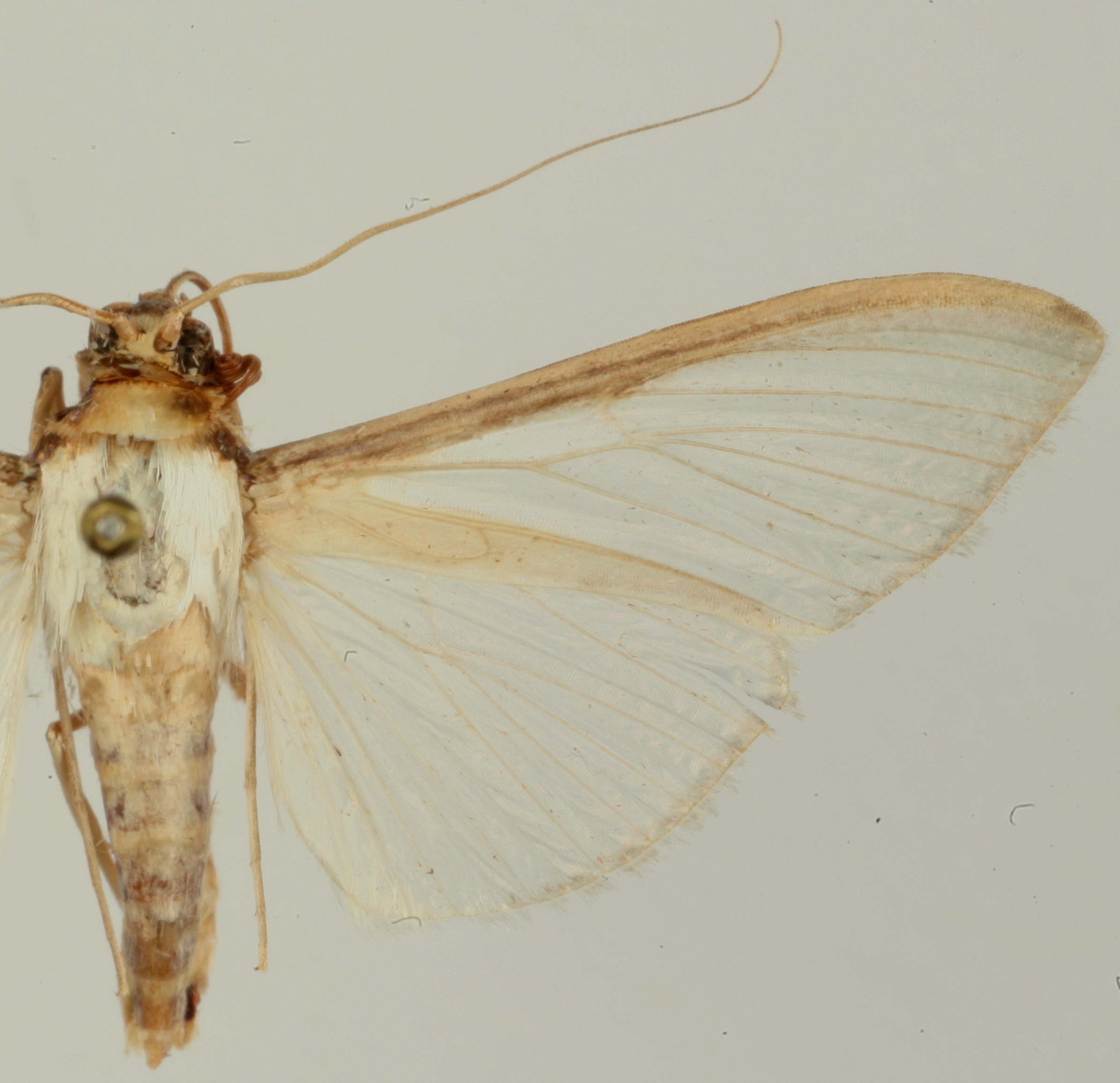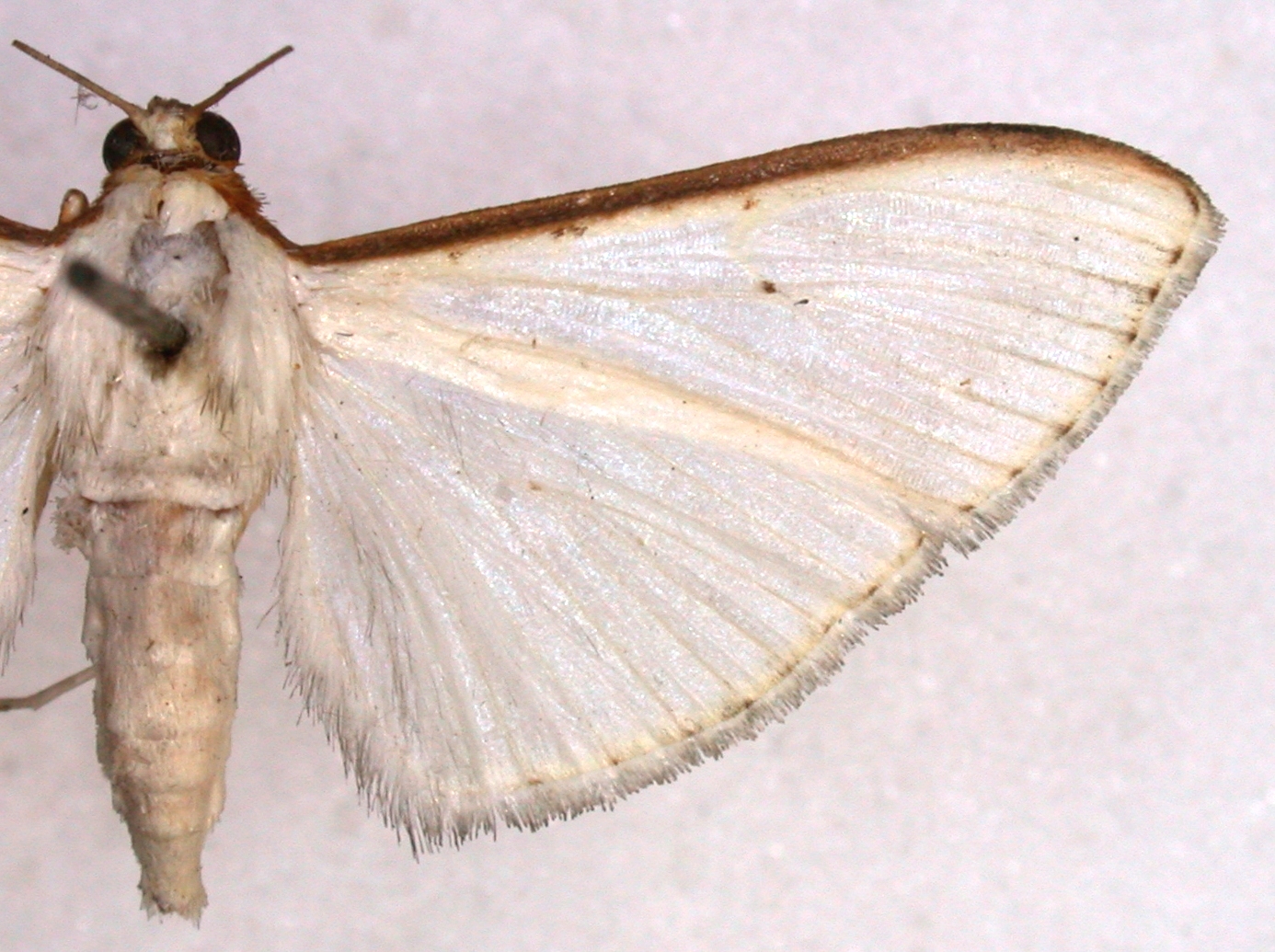
Cydalima vitrealis Rossi
- Family: Crambidae
- Subfamily: Spilomelinae
- Tribe: Margaroniini
- Genus: Cydalima
- Distribution: Worldwide mainly subtropical & tropical. Central America, Europe (S), Middle East, Africa (W), Mauritius, India (Maharashtra), Burma, Sabah, Irian Jaya, China (Yunnan), Australia (Q).
- Habitat: Lowland to subalpine cultivated areas <2,500m.
- Wing Length: 13.5mm
Taxonomy
The holotype of Phalaena vitrealis Rossi, 1794: 42 is from Italy (Etruria).
- syn. Pyralis unionalis Hübner, 1796: 12; pl. 20, fig. 132. TL Austria. Syn. n. (Lerault 1997: 173, 302).
- syn. Botys quinquepunctalis Boisduval, 1833: 117, pl. 16, fig. 5. TL La Réunion [Bourbon Is.];
- syn. Margarodes transvisalis Guenée 1854: 304 TL Central Africa (Namaquois) The ♂ type in the BMNH is in bad condition (see Guenée 1854: 304);
- syn. Margarodes septempunctalis Mabille, 1880: 25. TL Madagascar (the syntype is is missing).
Description
The jasmine or olive leaf moth. Tropical and temperate & worldwide migrant. FW & HW shining translucent white with a minute black discal spot. FW costa edge is brown with three or four minute dark spots present close to the costal. The termenae have tiny black neural punctae. The head, thorax and abdomen are mainly white but the humeral area of the thorax is dark brown. The male has a conspicuous anal tuft of long grey and white setae. It is Included in the key to the spp. of Palpita found in India (Kirti & Rose, 1992: 63-65). [P. warrenalis, P. nigropunctalis, P. palpifulvata, P. annulata, P. pajnii, P. kiminensis, P. unionalis & P. hexcornutialis].
Life History
An important pest of olives (Olea europea). Other food plants include jasmine (Jasminum spp.), privet (Ligustrum spp.), ash (Fraxinus spp.), Oleacea, and strawberry tree (Arbutus unedo) Ericaceae. The moth deposits eggs individually or in small masses (6-36 eggs) on the undersides of olive leaves. In the later instars (3-5), the head is a dark yellow brown with the first thoracic segment a light yellow colour with rest mostly were light green in colour with a lateral black spot on each thoracic segment. The pupae are formed in a slight web attached to the food plant, Initially they are light green in colour with light green to brown areas over the abdomen and green over the wings and head. After 24 hours the pupae turned brown. Sevastopulo (1944: 425) describes the early stages and Yilmaz & Genç. (2012) give further details.
References
- Boisduval, J.B.A. (1833a) Faun. Ent. Madag. Bourbon et Maurice, Lepidopt. Roret, Paris. 122 pp., 16 pls. [in French]. Hübner, J. (1796-1836 [1796]) Pyr. 6: 21 in; Zuträge zur Sammlung exotischer Schmettlinge [sic] bestehend in Bekundigung einzelner Fliegmuster neuer oder rarer nichteuropäischer Gattungen, Vols 1-8, Augsburg. Guenée, M. A. (1854) Deltoïdes et pyralites. In Boisduval, J.A. & Guenée, A., Hist. nat. des Insectes (Spec. gén. Lépid.) Vol. 8, 448pp. + 10 pls., Librarie Encyclopédique de Roret: Paris. Hübner (1796) Pyr. 6, :12, fig.132 in Hübner, J. (1796-1838) Zuträge zur Sammlung exotischer Schmettlinge [sic] bestehend in Bekundigung einzelner Fliegmuster neuer oder rarer nichteuropäischer Gattungen, Vols 1-12, Augsburg. [In German] Mabille, M.P. (1880a) Diagnoses Lepidopterum Malagassicorum. Annales de la Société Entomologique de Belgique 23:16-27. [In French] Rossi, P. (1792-1794) Mantissa insectorum, exhibens species nuper in Etruria collectas, adjectis faunae Etruscae illustrationibus ac emendationibus. Petro Rossio adiectis faunae [Mant. Ins.] Typographìa Polloni, Pisis [= Pisa]; Vol 1 [1792]: 148 pp.; Vol 2 [1794]: 154 pp., 8 pls. Sevastopulo, D.G. (1944). The early stages of Indian lepidoptera, J. Bombay Nat. Hist. Soc. 44 (XI) (3) 415-425. Yilmaz, C. & Genç. H. (2012) Determination of the life cycle of the olive fruit leaf moth, Palpita unionalis (Lepidoptera: Pyralidae) in the laboratory. Florida Entomologist (95) 1: 162-170.
- Kirti, J. S. & Rose, H. S. (1992) Studies on Indian species of the genus Palpita Hubner (Lepidoptera: Pyralidae: Pyraustinae): J. Ent. Res. New Delhi, 16 (1): 62-77.