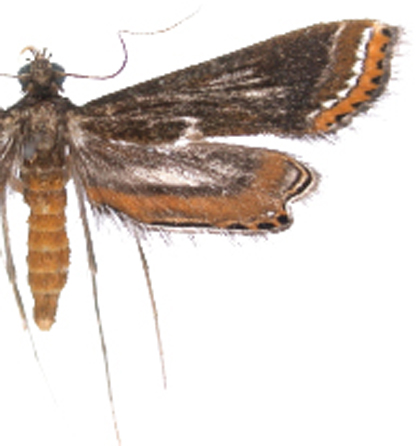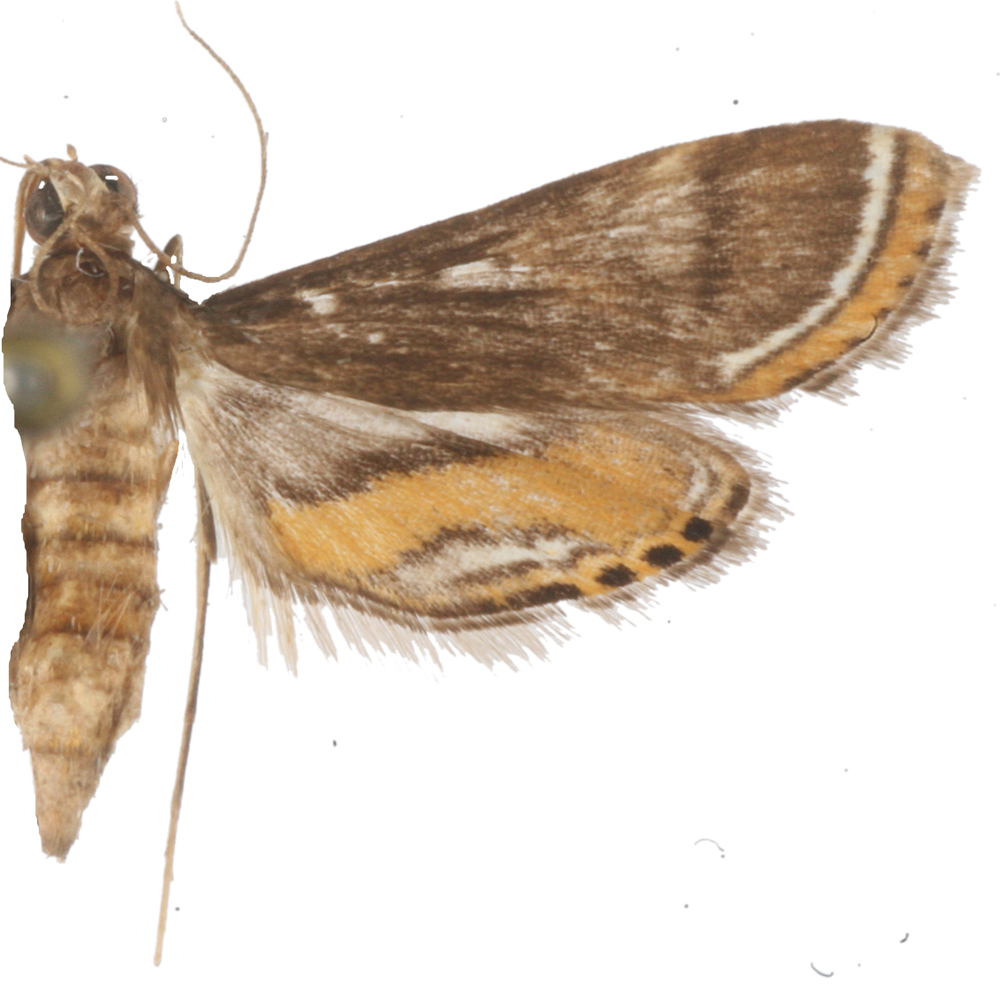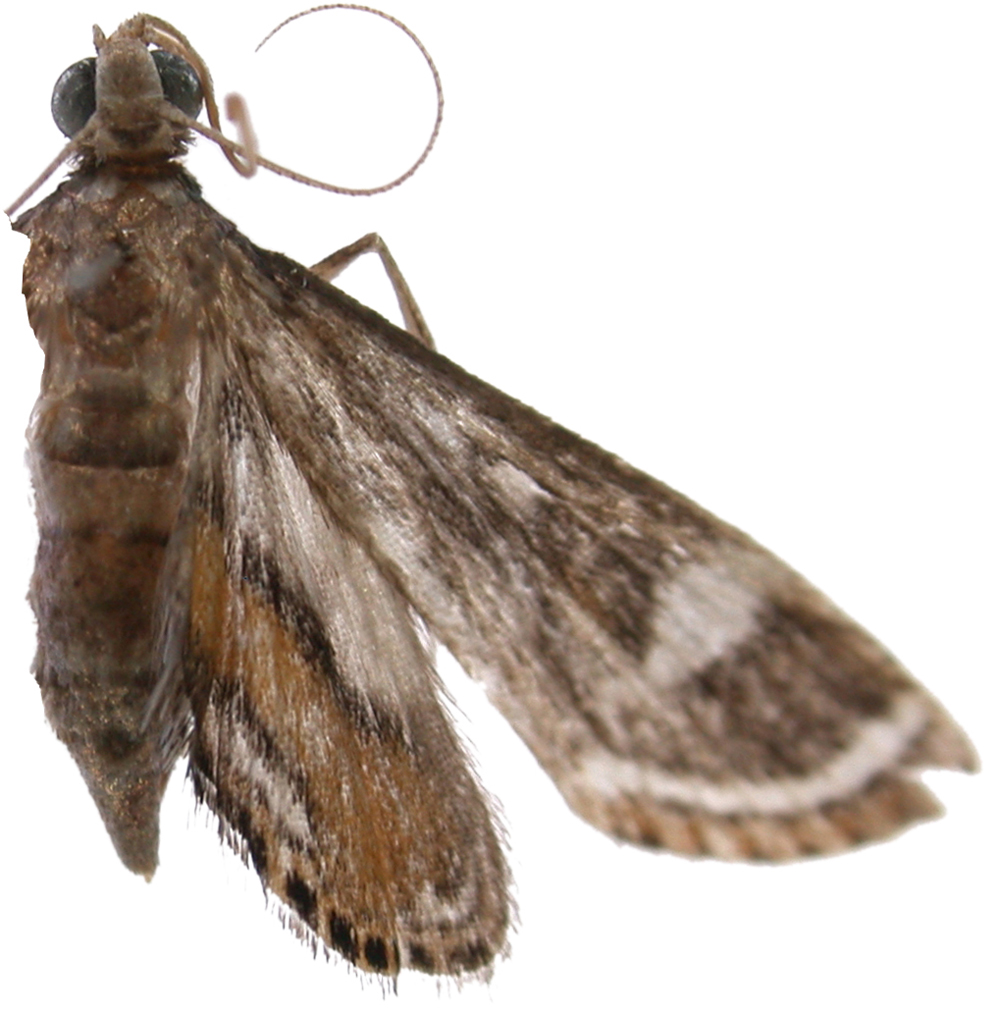
Strepsinoma croesusalis Walker
- Family: Crambidae
- Subfamily: Acentropinae
- Genus: Strepsinoma
- Distribution: India (Assam, Andaman Is.), Thailand, W. Malaysia, Sabah, Sarawak, Kalimantan Selatan, China (Hong Kong), Taiwan.
- Habitat: Lowland streams, forest (mainly primary) & cultivated areas; <610m.
- Wing Length: 9mm
Taxonomy
The holotype of Cataclysta croesusalis Walker 1859: 449 from Sarawak collected by A.R. Wallace, is in the Oxford UMNH.
- syn. Oligostigma hapilistale Strand 1919: 105. Syn. n. (Speidel & Mey 1999), TL Taiwan.
- syn. Cataclysta trigonialis Swinhoe 1895: 304. TL India [Meghalaya] Shillong. As a syn. in LepIndex.
The Strepsinoma croesusalis complex comprises a group of spp. with unresolved taxonomic relationships ranging throughout SE Asia.
Description
A brown, white and fulvous sp. The FW has a broad orange marginal area with a narrower white submarginal band. A triangular white mark extends from the FW costa post medially. The HW has a broad fulvous band with brown basally and a narrow white sub-marginal band. The margin has four small black eye spots. Yoshiyasu (1987: 151-152 figs. 7,8, 32C) gives a full re-description and illustrates the genitalia. Many Bornean specimens near S. croesusalis Walker, 1859 have the white trianglular area of the FW reduced or suffused with brown. The status of such morphotypes needs evaluation. See Strepsinoma spp. 1, 2, 3 & 4.
Life History
The larvae dwell in fast running water, building silken-webs on rocks, and feeding on diatoms. The adults often rest gregariously beneath a big tree leaf. Photo of this in Hong Kong by S.-H. Yen in Pyraloid Planet, (Landry 2006: 7). At GTE, Stefano Turillazzi discovered congregations of apparently recently emerged Strepsinoma croesusalis Walker mixed with a small number of Eoophyla ceratucha Meyrick, 1885 on the underside of the tip of a Seraca leaf about 7m above the water, and another similar congregation on the tip of a frond of a Salak Palm. The first congregation remained in place for three days (See Photo). This sp. was a common pyralid pollinator on the flowers of Neonauclea pallida (Rubiaceae) noted by Weber (2000a,b).
References
- Meyrick, E. (1885) X On the classification of the Australian Pyralidina Trans. ent. Soc. Lond. 1885 (4): 421-456.
- Strand, E., (1919) H. Sauter’s Formosa-Ausbeute: Pyralididae, Subfam. Sterictinae, Endotrichinae, Pyralidinae und Hydrocampinae (Lep.). Entomologische Mitteilungen, 8: 102-110.
- Yoshiyasu, Y. (1987) Microlepid. Thailand, 1: 133-185.
- [RTS] Robinson, G.S., Tuck, K.R. & Shaffer, M. (1994) A Field Guide to the Smaller Moths of South-East Asia, Malaysian Nature Society Kuala Lumpur & Natural History Museum, London, 311 pp. 51 text figs, 32 pls.
- RTS (1994): 67, pl.27, fig. 14.
- Landry B. [Ed.] (2006) Pyraloid Planet Vol. 1, 7 pp.
- Walker, F. (1859c). Pyralides. In; List Spec. Lepid. Ins. Coll. B. M., Cat. Lepid. Heterocera. 17: pp. i-iiv, 255-508.
- Swinhoe, C. (1895b) New Species of Indian Epiplemidae, Geometridae, Thyrididae and Pyralidae. Ann. Mag. nat. Hist., Ser. 6, 16 (XLIII) 293-304.
- Weber, C. F. (2000b) Bestäubung von Neonauclea pallida (Rubiaceae) durch Pyraliden in Süd-Thailand. [Pollination of Neonauclea pallida (Rubiacea) by pyralid moths in Southern Thailand]. Linzer biol. Beitr. 32 (2): 247. [in German]
- Weber, C.F. (2000a) Bestäubung von Neonauclea pallida (Rubiaceae) durch Pyraliden in Süd-Thailand. [Pollination of Neonauclea pallida (Rubiaceae) by pyralid moths in Southern Thailand]. Unpubl. M. Phil Thesis, Institut fur Botanik, Universität Wien , Austria . [in German]
- Speidel, W. & Mey, W. (1999b) Catalogue of the oriental Acentropinae (Crambidae, Pyralidae). Tijdschr. v. Entomol. 142: 125-142, figs. 1-3.