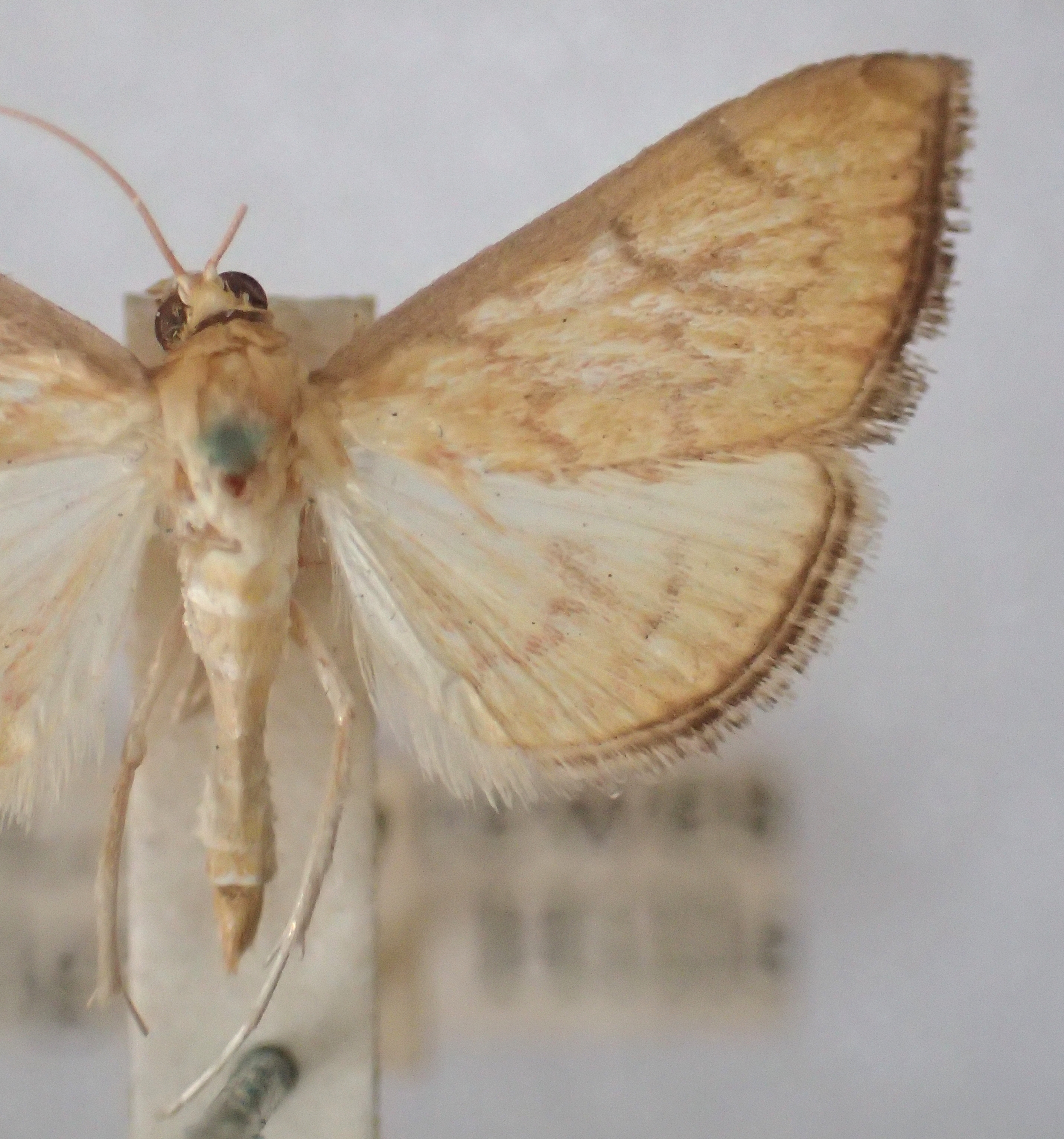
Paliga machoeralis Walker
- Family: Crambidae
- Subfamily: Pyraustinae
- Genus: Paliga
- Distribution: Sri Lanka, India (Tamil Nadu, Maharashtra), Burma, Thailand, W. Malaysia Indonesia (Java), Australia, Taiwan.
- Habitat: Lowland & hill forest <1500m.
- Wing Length: 6.5mm
Taxonomy
The female holotype of Scopula machoeralis Walker 1859: 1031 by original designation (but cited as machaeralis, an incorrect subsequent spelling). TL Sri Lanka. It is the TS of Eutectona Wang & Sung, 1980.
- syn. Udaea machaeralis Moore, 1886: 349. An incorrect subs. spell.
- syn. Botys egenalis Lederer, 1863: 372, 468, Pl. 10, fig. 7. TL suposedly from Venuzuela but subsequently known to be from Ost Indien [East India, S & E Asia].
- syn. Harpalia albicostalis Swinhoe, 1890: 271. TL Burma (Rangoon) Chatterjee (1941: 177), sinks it to machoeralis Walker.
- syn. Asopia rufipicta Butler, 1880: 682–683. TL Taiwan.
Its differences from the closely related Paliga damastesalis Walker, 1859:1013, are slight and the two may be conspecific (Nair, 2007) but for the moment we treat it as a good species.
Description
A pale yellowish sp. both wings with a pale pink-purple lineation. Similar to Paliga damastesalis but with a much simpler patterning. The FW has dentate antemedian and post-median lines. The latter being withdrawn to the median position centrally (looped). The FW has an elongate mark in the cell. The FW veins are prominent in pale pink-purple and end at a series of triangular neural spots on the termen. The HW is less distinctly marked with partial median, post-median and subtermenal lines. Palpi beneath, legs, & body beneath white, fore tibiae ochreous-yellow. The colours show considerable differences according to climatic differences. Pale ochraceas varieties are hot dry or hot wet seasonal forms, dark & brick red varieties are Spring and cold seasonal forms (Chatterjee 1941: 177). However note some specimens from India ostensibly P. machoeralis have a very distinct lineation in a vivid red and may be an undescribed Ecpyrrhorrhoe sp.. P. machoeralis has not been reported from Borneo.
Life History
Hole (1904: 680-697, pl. A, figs. 1-3, pl. D, figs 17-20 describes and illustrates the development stages. The caterpillars are serious leaf skeletonising pest of teak (Tectona grandis) Lamiaceae which Hole suggests is the only host plant. The larvae are attacked by Ichneumons, spiders and fungal diseases and they are also eaten by Bulbuls. However bearing in mind the early confusion between P. damastesalis & machoeralis this may be information refering to P. damastesalis.
References
- Moore, F. (1884-1887 [1886]) Lepid. Ceylon., Vol 3, IX-XIII, xv + 578pp., pls. [71] 144-215 L. Reeve & Co., London.
- Hampson, G.F. (1896) Moths, Vol. IV, In Blandford, W.T. (ed.), The Fauna of British India including Ceylon and Burma, W.T., Taylor and Francis, London: xxiii + 594pp.
- Hole, R.S. (1904) Two notorious insect pests. J. Bombay nat. Hist. Soc.: 15: 679-681, plates A-D.
- Chatterjee, P.N. (1941) On the nomenclature and seasonal forms of Harpalia machoeralis. Indian J. Ent., 3: 177-178.
- Nair, K. S. S. (2007). Tropical Forest Insect Pests. Ecology, Impact, & Management, Cambridge University Press: 404pp. 10.1017/CBO9780511542695.
- Swinhoe, C. (1890b) The Moths of Burma, Pt. 2. Trans. ent. Soc. Lond.: 201-296, pls. 6-8.
- Walker, F. (1859e) Pyralides, In; List Spec. Lepid. Ins. Coll. B. M., Cat. Lepid. Heterocera. Ser. 4, 19: 799-1036.