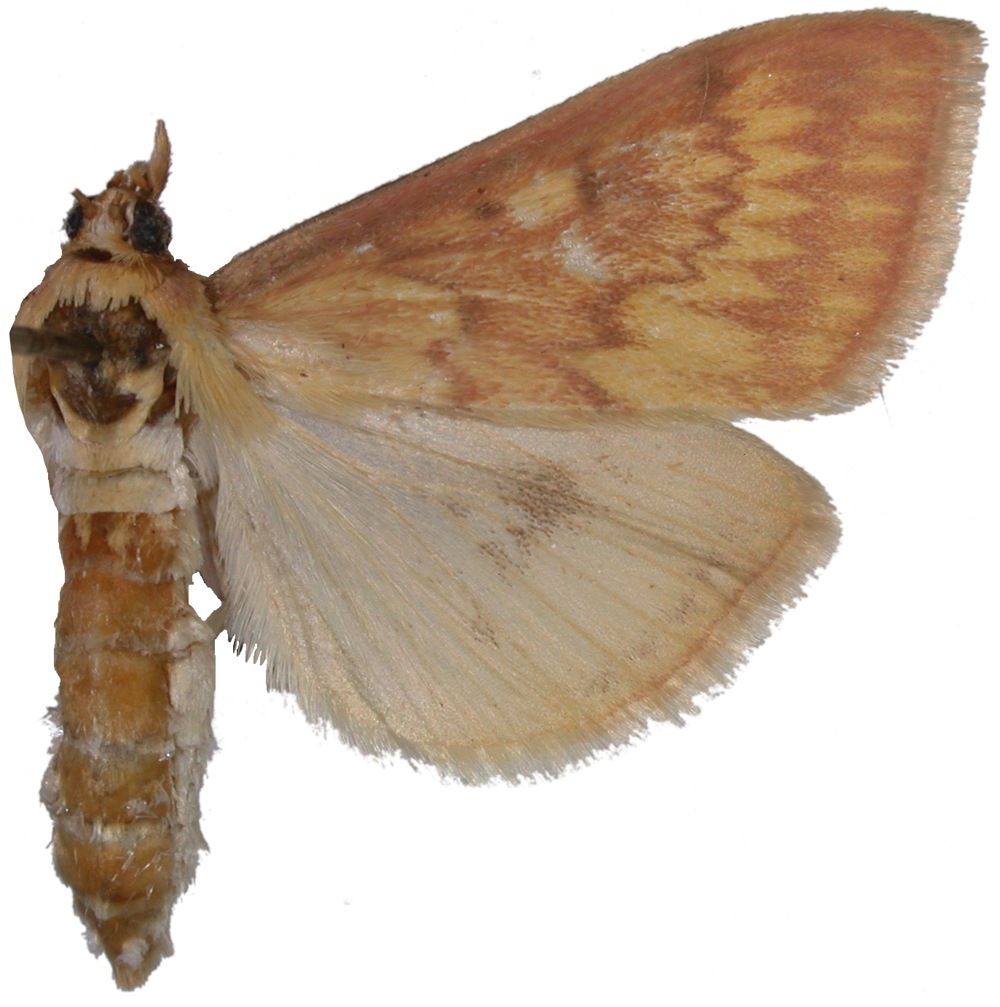
Ostrinia furnacalis Guenée
- Family: Crambidae
- Subfamily: Pyraustinae
- Genus: Ostrinia
- Distribution: Sri Lanka, India (Moluccas), Bhutan, Burma, Vietnam, Thailand, W. Malaysia, Singapore, Sabah, Sarawak, Kalimantan, Sumatra, Java, Sulawesi, Timor, Irian Jaya, PNG, Australia, Solomon Is. Seram, Moluccas, Sulawesi, Philippines, China (Shanxi, Shanghai, Hong Kong, Hennan), Taiwan, Korea, Japan.
- Habitat: Lowland to lower montane; <1400m.
- Wing Length: 16mm
Taxonomy
The holotype of Botys furnacalis Guenée, 1854 from Australia (New Holland) is in the BMNH London.
- syn. Botys damoalis Walker, 1859: 656. TL China (Shaghai); type in BMNH. Syn. n. (Mutuura & Munroe 1970);
- syn. Botys salentialis Snellen, 1880: 207. TL Sulawesi Bonthain; type in RMNH Leiden. Syn. n. (Mutuura & Munroe 1970)
- syn. Spilodes kodzukalis Matsumura, 1897: 237. Type from Japan not traced. Syn. n. (Mutuura & Munroe 1970);
- syn. Pyrausta polygoni Dyar, 1905: 995-996; Type from Japan (Gifu) is in the USNM. Syn. n. (Mutuura & Munroe 1970);
- syn. Pyrausta vastatrix Schultze, 1908. Type from Philippines (Manila) destroyed. Syn. n. (Mutuura & Munroe 1970);
Comb. n. to Ostrinia Hübner, [1825] 1826 Mutuura & Munroe (1979).
Mutuura & Munroe (1970) recognized 20 Ostrinia spp. classified into three groups according to the number (1, 2 or 3) of lobes of the uncus. They further divided the 10 spp. of the trilobed uncus group into three subgroups. These spp. are confusingly similar in external appearance, except for the male mid-tibia morphology which can be 'small' (i.e. simple), 'medium' (i.e. with a groove and a few large scales), or 'massive' (i.e. enlarged, strongly grooved, with complicated scale patterns and one or several hair tufts).
Description
A handsome and distinctive pink and yellow sp. The notorious ‘asian corn borers’ Ostrinia scapulalis, O. narynensis and O. furnacalis are sibling spp. which co-exist in parts of their geographical ranges. RTS (1994) considered furnacalis the ‘only Ostrinia sp. in SE Asia’ a statement supported by Frolov et el. (2007).
Life History
An important pest species. A stalk & ear borer of Zea mays (maize), and many other crops especially Poaoacea and Polygonaceae. Also: cotton, tomato, tobacco, sugarcane, ocra & soybean (Pabbage et al. 2007).The larvae of O. furnacalis attack all parts of the maize plant. Yield losses are greatest when damage occurs at the reproductive stages. Late-instar larvae bore into the stem or branches of host plants or webbed groups of florets or branches. They bore in the shank and cob in the ear or feed on silk or kernels. The stalk is the most common feeding site for final-instar larvae. Control using pesticides or pheromone traps is most common but cultural control including early planting and detasselling can help. Biological control including Bacillus thuringiensis or parasitoids will also work. In Indonesia a female can lay eggs 80-140/days and can total 300-500. The eggs masses are laid at a night, mostly on under side of three upper maize leaves (70%) but some of them on upper side of leaves (30%), each egg mass consist of 5-90 eggs. The egg stage takes 3-4 days. After hatching the larvae will feed until the sixth instar, over a period of 17-30 days, then pupating inside the stalk for 7-9 days. The adult are usually active at night time and will mate immediately and deposit eggs after a week. (Kalshoven, 1981; Nonci, 2004; Pabbage et. al., 2007).
References
- Guenée, A. (1854) Deltoïdes et pyralites. In Boisduval, J.A. & Guenée, A., Hist. nat. des Insectes (Spec. gén. Lépid.) Vol. 8, 448pp. + 10 pls., Librarie Encyclopédique de Roret: Paris.
- Snellen, P. C. T., (1880) Nieuwe Pyraliden op het eiland Celebes gevonden door Mr. M. C. Piepers. Tijdschr. v. Ent. 23: 198-250.
- Matsumura, S. (1897) Gaichu Kujo Zensho [Insect Pest Control Book]: 237.
- Dyar, H.G. (1905) A descriptive list of a collection of the early stages of Japanese Lepidoptera. Proc.U.S. Nat. Mus., 28: 937-956.
- Conway, G. & Tay, E.B. (1968) Crop pests in Sabah, Malaysia and their control: With a provisional check list of insects and other animals of agricultural importance in Sabah. Kementerian Pertanian dan Perikanan Sabah, Malaysia [State Ministry of Agriculture and Fisheries (Sabah, Malaysia)].
- Mutuura, A. & Munroe, E. G. (1970) Taxonomy and distribution of the European Corn Borer and allied species: genus Ostrinia (Lepidoptera: Pyralidae). Mem. ent. Soc. Can., 71: 1-112.
- Kalshoven, L.G.E. (1981) The Pests of Crops in Indonesia. Rev. & transl. by Van der Laan, P.A & Rothschild, G.H.L. Ichtiar Baru-Van Hoeve, P.T., Jakarta, Indonesia, 701pp.
- RTS (1994): 181, pl.30, fig.5.
- Nonci, N. (2004) Biologi dan musuh alami penggerek batang Ostriia furnacalis Guenee (Lepidoptera:Pyralidae) pada tanaman jagung. Jurnal Litbang Pertanian, 23 (1).
- Frolov, A.N., Bourget, D. & Ponsard, S. (2007) Reconsidering the taxomony [sic] of several Ostrinia species in the light of reproductive isolation: a tale for Ernst Mayr. Biol. J. Linnean Soc., 91, 49–72.5 figs.
- Pabbage, M.S., A.M. Adnan, & Nonci, N (2007) Pengelolaan hama prapanen Jagung in Jagung . Balai PenelitianTanaman Sereal.
- Soffan, A. ([2009] unpubl.) Control Program for the Most Important Pest[s] in Corn. Department of Plant Protection, King Saud University, Riyadh, Saudi Arabia. pp16.
- Walker, F. (1859d [May 10]) Pyralides, In; List Spec. Lepid. Ins. Coll. B. M., Cat. Lepid. Heterocera. Fourth Series 18: 509-799.