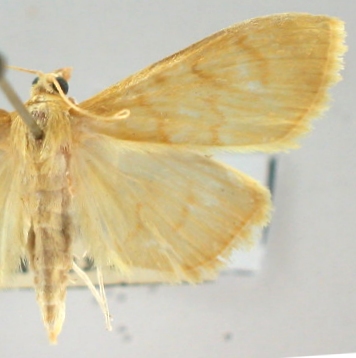
Ecpyrrhorrhoe puralis South
- Family: Crambidae
- Subfamily: Pyraustinae
- Genus: Ecpyrrhorrhoe
- Distribution: USA (naturalized), Sabah, Brunei, Kalimantan Timur, Solomon Is. China (Hubei, Hong Kong), Korea, Japan.
- Habitat: Lowland primary forest <650m.
- Wing Length: 12.5mm
Taxonomy
The holotype of Pionea puralis South, 1901: 492 is from China (Ichang [Yichang]) It is in the BMNH. comb. n. to Ecpyrrhorrhoe (Zhang et al 2004).
- syn. Phlyctaenodes ochrealis Wileman, 1911: 384. TL Japan.
As Paliga in Inoue 1982, As Loxostege in LepIndex. In neither genera was it well placed. Here we treat it in Ecpyrrhorrhoe where it was placed by Zang et al. (2004: 315).
A specimen illustrated is DNA barcoded in BOLD: The Barcode of Life Data System (Sample ID RMNH INS #19590) as Loxostege ochrealis. It is from the Gunung Lumut Protection Forest (van Tol, 2005).
Several specimens have been DNA barcoded in BOLD as ochrealis Wileman, but their identities are confused e.g. specimens (RMNH Ins ID #19592 and USNM ENT 00731033) are probably Ecpyrrhorrhoe sp. but may not be conspecific.
It may be the same as Ecpyrrhorrhoe celatalis Walker, 1859.
Description
A pale yellow orange species with transverse lines on both wings and a moderately elongate abdomen. See illustrations of Paliga ochrealis Wileman in Inoue (1982, pl. 43, figs 1,2,3). Solis et al. 2010 illustrate the adult and male and female genitalia. Do not confuse with Pagyda ochrealis Wileman, 1911:375. TL Japan, (Takohama), a supposedly junior subjective syn. of P. salvalis Walker 1859. In the Bold Taxonomy browser are several specimens misnamed as Pagyda ochrealis Wileman, which have been DNA sequenced e.g. (Sample ID USNM ENT 00731033) That is certainly an Ecpyrrhorrhoe but is not the like specimen illustrated by Inoue, nor Pagyda salvalis Wileman, 1911: 375. See Inoue 1982, pl. 43, figs 1,2,3 and see. Li et al. (2009) Pl. XII fig. 174 & figures of genitalia, Pl. XLVII fig. 174 (male) & Pl. LXXXV fig. 174 (female). See some Pagyda spp.. All Ecpyrrhorrhoe spp. are best determined by genitalic examination.
Life History
Although said to feed on Labiatae in Asia the USA population feeds on the introduced ornamental tree Paulownia tomentosa (Scropulariaceae) (Solis et al. 2010)
References
- South, R. (1901) XV, Lepidoptera: Heterocera from China, Japan and Corea, by the late John Henry Leech, B.Z., F.L.S., etc. Pt.V., with description of new species, Trans. Ent. Soc. Lond., :385- 514.
- Wileman, A. E. (1911) XV New and unrecorded species of Lepidoptera Heterocera from Japan, Tr. Roy. Ent. Soc. 59 (2): 189-407, pls. 30, 31.
- Zhang, D.-D., Li , H.-H & Wang, S.-X. (2004) A Review of Ecpyrrhorrhoe Hübner (Lepidoptera: Crambidae: Pyraustinae) from China, with Descriptions of New Species, Oriental Insects, 38 (1): 315-325, DOI: 10.1080/00305316.2004.10417397
- van Tol, J. [Ed.] (2005) Gunung Lumut Biodiversity Assessment 2005 [The naturalis contribution to the MOF-Tropenbos project in the Gunung Lumut Protection Forest] NMNH, Naturalis, Leiden, The Netherlands. 24pp.
- Ratnasingham, S. & Hebert, P.D.N.(2007) Barcoding - BOLD: The Barcode of Life Data System (www.barcodinglife.org), Molecular Ecology Notes (Journal compilation © 2007 Blackwell Publishing Ltd.: 10 pp.
- Li, H. H., Ren, Y. D., Zhang, D. D., Du, X. C., Li, W. C., & Ping Y. (2009) Insect Fauna of Henan, Lepidoptera: Pyraloidea. Science Press, Beijing, 440 pp.
- Solis, M.A. Scholtens, B.G. Adams, J.K. Funk, D.H. (2010) First report of Ecpyrrhorrhoe puralis (South) (Pyraloidea: Crambidae: Pyraustinae) in North America: A naturalized exotic pyraustine from Asia feeding on Paulownia, Siebold & Zucc. J. Lepidopterists' Soc. 64 (1): 33-35.