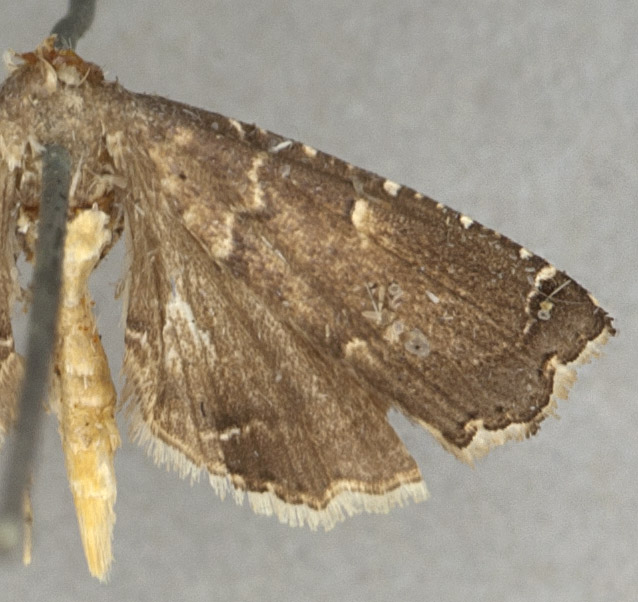
Diplopseustis perieresalis Walker
- Family: Crambidae
- Subfamily: Lathrotelinae
- Genus: Diplopseustis
- Distribution: India (Assam), W. Malaysia, Sabah, Sarawak, Indonesia, Australia, Fiji, New Zealand. China (Zhejiang, Shanghai, Hong Kong), Taiwan, Korea, Japan , New Zealand + (Antipodes Is., Chatham Is. & Kermadec Is.).
- Habitat: Primary forest including canopy & cultivated areas <650m.
- Wing Length: 6.5mm
Taxonomy
The holotype of Ambia perieresalis Walker, 1859: 958 collected by A.R. Wallace from Sarawak is in the Oxford University Museum; Type #871.
- syn. Cymoriza minima Butler, 1881: 684. The type from Taiwan (Takow) is in the BMNH.
- (syn. n. Hampson 1896: 489). This is the TS of Diplopseustis Meyrick 1884: 285;
- syn. Sufetula nana Warren, 1896: 225. TL: India (Bombay) The type is in the BMNH
- (syn. by Hampson 1896: 489). Comb. rev. to Diplopseustis (Hampson 1896: 489);
- syn. Diplopseustis perieralis [sic]; Dugdale 1973: 202;
- syn. Diplopseustis periersalis [sic]; Mackay & Fray 2002: 26 [first published record West Palaearctic];
- syn. Diploseustis [sic] perieresalis; (Evenhuis 2006: 6);
See Speidel et al. (2007) for synonyms and taxonomy.
Diplopseustis selenalis Hampson 1906: 213, TL New Guinea (Fergusson Is.), may also be a synonym. The type is in the BMNH.
Description
A mainly dull brown sp. with the wing margins slightly darker brown in some forms. The termen of both wings is sinuous. Two sinuous white lines cross the FW at the sub-termenal and ante-median positions. The HW has a similar line sub-termenally and a darker patch near the tornus. The FW costa has a series of small white lunules and there is a small dark discoidal lunule highlighted by white distally. Note the long porrect palpi. The head thorax and abdomen are brown. The abdomen has pale intersegmental membranes. There is slight sexual dimorphism. The male & female genitalia are illustrated in (Speidel et al. 2007: figs 3-6). They noted variability of the male valvae and that Dutch and New Zealand specimens were most similar. It is uncertain whether this is due to intraspecific variation alone. Their observation, however, stresses the need for a systematic revision of the genus Diplopseustis. Roh et al. (2014: 269 fig. 2A & :270 fig 3A) illustrate the male and female genitalia.
Life History
Carex spp. are possibly the larval host plant (Speidel et al. 2007).
References
- Walker, [1866] Cat. Lep. Ins. B.M., 19: 958.
- Dugdale, J. S. (1973) A note on Kermadec Islands Lepidoptera. New Zealand Entomologist, 5 (2):197–203.
- Hsiau Yve Wang & Spiedel, W. (2000) Guide to the Insects in Taiwan. (19) Pyraloidea (Pyralidae, Crambidae), Shu Shin Books, Taipei, Taiwan; 96, fig.
- Mackay, A. & R. Fray (2002) Diplopseustis periersalis [sic] (Walker) on Tresco, Isles of Scilly - the first record for Britain and the western Palearctic region. Atropos 16: 26.
- Evenhuis, N. L. (2006) Checklist of Fijian Lepidoptera. Bishop Museum Technical Report, 35 (13): 1–46.
- Speidel, W., Van Nieukerken, E. J. , Honey, M.R. & Koster, S.J.C.(2007) The exotic pyraloid moth Diplopseustis perieresalis (Walker) expanding in the West Palaearctic Region (Crambidae: Spilomelinae), Nota lepid. 29 (3/4): 185-192.
- Roh, S.J., Kim, S-S., Bae,Y-S., & Byun, B-K. (2014) Four Newly Recorded Species of the Family Crambidae (Lepidoptera) from Korea. Anim. Syst. Evol. Divers. 30, (4): 267-273.
- Walker, F. (1859e) Pyralides, In; List Spec. Lepid. Ins. Coll. B. M., Cat. Lepid. Heterocera. Ser. 4, 19: 799-1036.