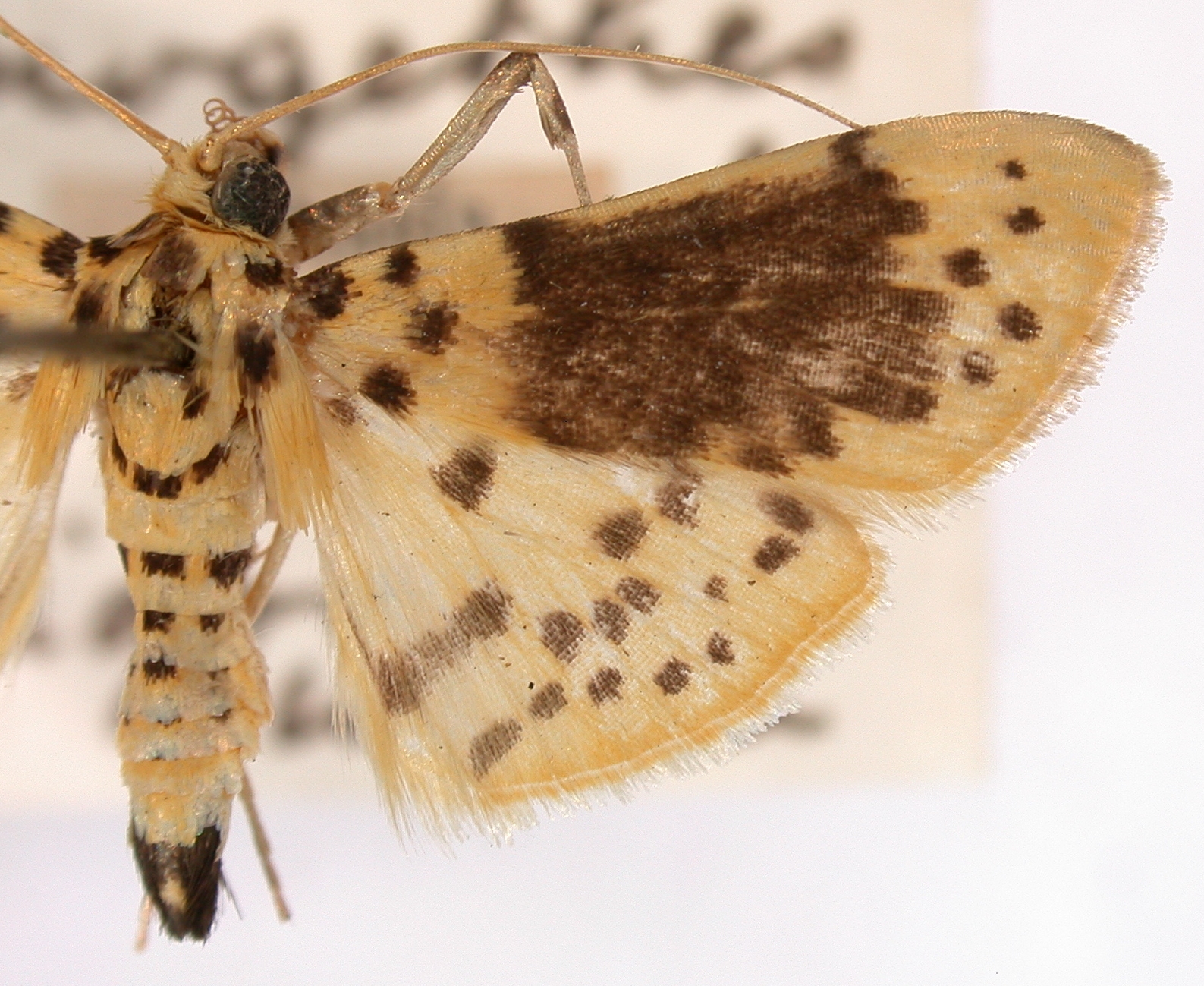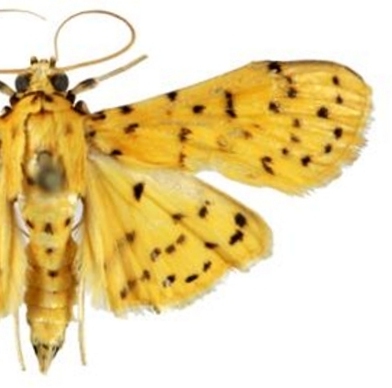
Conogethes sahyadriensis Shashank
- Family: Crambidae
- Subfamily: Spilomelinae
- Tribe: Margaroniini
- Genus: Conogethes
- Distribution: Sri Lanka, India (S.W., Karnataka, Kerala).
- Habitat: Lowland agricultural areas <1000m.
- Wing Length: 10mm
Taxonomy
Conogethes sahyadriensis Shashank et al. 2018: 215-234,
(Figs 1, 2, 6, 9, 12, 15, 17, 19, 21, 23). The male holotype is deposited in the National Pusa Collection [NPC]. TL India (Karnataka, Chikmagalur). There are 21 paratypes from the same locality. This Conogethes sp. is part of the clade of C. cf. punctiferalis sensu Shashank et al. (2018: 229) and as such can not be easily identified except by DNA sequencing.
The DNA barcode of C. sahyadriensis is not shared with the other spp. considered in Shashank et al. (2018).
Description
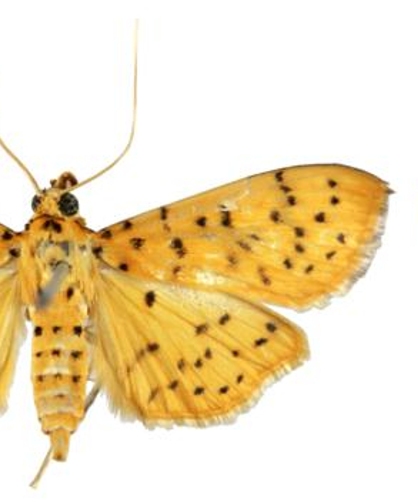
An orange-yellow sp with black maculation. Male and female colouration is similar but the females have a slightly larger wingspan 27.5mm compared with 25.5mm of the males. It has a very distinct spot near the HW base. The frons is pale yellowish, vertex with dense whitish yellow scales Its yellow, black spotted, abdomen has a black tip. It has smaller spots much less distinct than those of the holotype of C. punctiferalis [partim] Guenée, 1854: 320 but C. sahyadriensis is distinguished from the sympatric C. punctiferalis by the second segment of labial palp being broadly tinted with black fuscous and the metathorax dorsally having two spots of black scales instead of three. It closely resembles C. parvipunctalis Inoue & Yamanaka, 2006: 87–88, figs 6, 14, 17, 17a. but it is distinguished by the larger wing size, the larger discocellular black spots on the hind wing and by the female genitalia. C. evaxalis (Walker, 1859) has a broad brown band across the labial palps like C. sahyadriensis, but the metathorax has three dark spots dorsally, the distal tarsus of the male hindlegs comprises a distinct tuft of dark hairs, the male HW has a large dark spot in the anal area. C. sahyadriensis is distinguished from C. pinicolalis Inoue & Yamanaka, 2006: 86-87, figs 4-5, 9, 11, 13, 16, 16a, 20 [TL Japan] by the pale-yellow apex on the ventral side of the FW, which is tinted brown in C. pinicolalis, sometimes also with the area between postmedial and submarginal series tinted brown, and by the absence of a large tuft of fuscous scales on the male hindlegs distal tibia and first tarsus segment. C. sahyadriensis and C. pluto are identical in the colouration of the labial palps, with two dark spots on the dorsal metathorax, and in wing maculation, and cannot be distinguished based on these characters. The male genitalia are distinctive. C. nicippealis (Walker 1859) is also similar. Shashank et al. (2018) details the genitalic characteristics and illustrate the male genitalia of Conogethes sahyadriensis; C. pluto, & C. punctiferalis [partim] and The female genitalia of Congethes sahyadriensis & C. punctiferalis [partim]. This sp. is currently considered restricted to Sri Lanka &India.
Life History
A pest of Green cardamom (Elettaria cardamomum), Zingiberaceae
Chakravarthy et al. (1991), identified two different C. punctiferalis lineages based on different mass-rearing techniques of larvae infesting castor (Ricinus communis L.) Euphorbiaceae & cardamom. Subsequently, Shashank (2012) and Shashank et al. (2014a, b) investigated these two lineages and reported differences between them in the morphology of the male and female genitalia and of the larvae and pupae. The larvae of C. punctiferalis & C. sahyadriensis do not differ in the morphology and chaetotaxy of the larva and the pupa, but there are differences in the egg sculpting. It has five larval instars and completes its life cycle in around 39 days. The detailed biology of C. sahyadriensis is given in Doddabasappa et al. (2014) under C. punctiferalis feeding on cardamom.
References
- Guenée, A. (1854) Deltoïdes et pyralites. In Boisduval, J.A. & Guenée, A., Hist. nat. des Insectes (Spec. gén. Lépid.) Vol. 8, 448pp. + 10 pls., Librarie Encyclopédique de Roret: Paris.
- Inoue, H. & Yamanaka, H. (2006) Redescription of Conogethes punctiferalis (Guenée) and description of two new closely allied species from Eastern Palaearctic and Oriental regions (Pyralidae: Pyraustinae). Tinea, 19 (2), 80-91.
- Shashank, P. R. (2012 unpubl.) Biosystematics and pheromone components of Conogethes punctiferalis (Guénee) (Lepidoptera: Crambidae) with special reference to populations infesting Castor (Ricinus communis L.) and Cardamom (Elettaria cardamomum Maton), Ph.D thesis, UAS, GKVK, Bangalore 65pp.
- Shashank, P. R., Chakravarthy, A. K., Chandrashekharaiah, R. & Bhanu, K. R. M. (2014b) Behavioural studies on Shoot and Fruit Borer, Conogethes punctiferalis Guenée, (Crambidae: Lepidoptera) host-associated populations reveal occurrence of cryptic species. Entomologia Generalis, 35 (2), 103-115. https://doi.org/10.1127/0171-8177/2014/0047
- Doddabasappa, B., Chakravarthy, A. K. & Thyagaraj, N. E. (2014) Comparative biology of shoot and capsule borer, Conogethes punctiferalis (Guenée), (Crambidae: Lepidoptera) on castor and cardamom. Current Biotica, 8 (3), 228-245.
- Shashank, P . R., Doddabasappa, B., Kammar, V., Chakravarthy, A. K. & Honda, H. (2015) Molecular Characterization & Management of Shoot and Fruit Borer Conogethes punctiferalis Guenée (Crambidae: Lepidoptera) Populations Infesting Cardamom, Castor and other Hosts. In A. K. Chakravarthy (ed.), New Horizons in Insect Science: Towards Sustainable Pest Management: 207-227. https://doi.org/10.1007/978-81-322-2089-3-20
- Shashank, P.R., Kammar, V., Mally, R. & Chakravarthy, A.K. (2018) A new Indian species of shoot and capsule borer of the genus Conogethes (Lepidoptera: Crambidae), feeding on cardamom. Zootaxa 4374 (2): 215-234.
- Shashank, P. R., Chakravarthy, A. K., Raju, B. R. & Bhanu, K. R. M. (2014a) DNA barcoding reveals the occurrence of cryptic species in host-associated population of Conogethes punctiferalis (Lepidoptera: Crambidae). Appl. Ent. & Zoology, 49, 283-295. https://doi.org/10.1007/s13355-014-0248-0
- Walker, F. (1859e) Pyralides, In; List Spec. Lepid. Ins. Coll. B. M., Cat. Lepid. Heterocera. Ser. 4, 19: 799-1036.