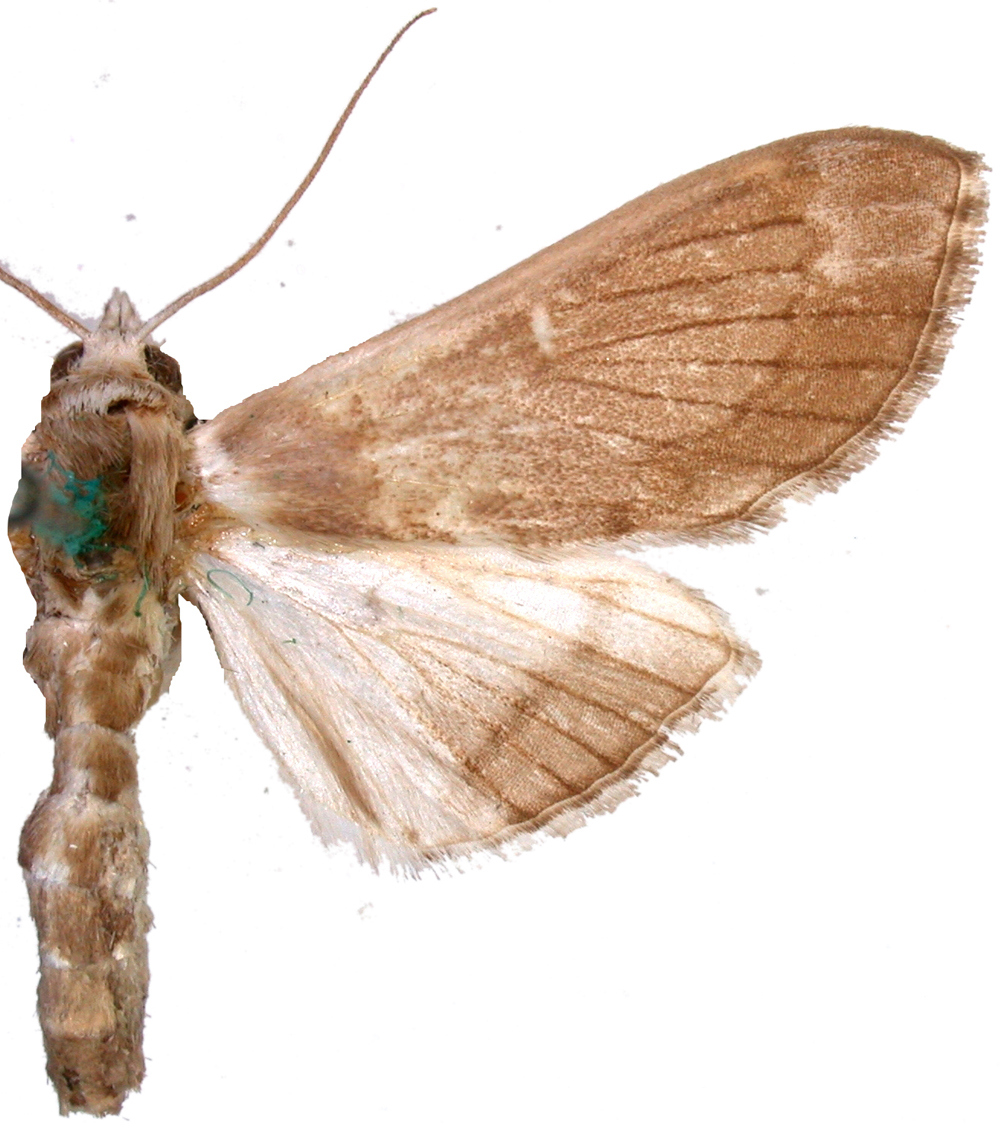
Cirrhochrista spissalis Guenée
- Family: Crambidae
- Subfamily: Spilomelinae
- Genus: Cirrhochrista
- Distribution: India (Assam), W. Malaysia, Sabah, Indonesia (Java, Bali, Sulawesi, Sumatra), Philippines. Taiwan, Japan (Iriomote Is.).
- Habitat: Primary & secondary forest, scrub & disturbed areas <610m.
- Wing Length: 15mm
Taxonomy
The female holotype of Botys spissalis Guenée, 1854: 326-327 is from Java. ms comb. n. to Cirrhochrista. ms comb. n. Munroe 1976 (on LepIndex card). As Cirrhochrista in LepIndex & Globiz. Occasionally treated as Pachybotys (Sugiura & Yamazaki 2004, Chen et al. 2006).
Note the C. spissalis group, based on Botys spissalis by Chen et al. (2006), may not be well placed in Cirrhochrista. Although Botys spissalis Guenée 1854 is the TS of Pachybotys Warren 1895: 476, a genus currently correctly syn. with Cirrhochrista.
Cirrhochrista is only provisionally included in the Spilomelinae. Hampson (1895) placed Cirrhochrista in the Crambidae, Schoenobiinae. Shibuya (1928) and Marumo (1934) followed this classification possibly supported by the shape and length of the palpi. However, Inoue (1982) transferred Cirrhochrista to the subfamily Pyraustinae. Chen et al. (2006) consider the genus to belong to the subfamily Schoenobiinae as Pachybotys but their paper gives no taxonomic information to support this. We tentatively retain it in the Spilomelinae.
Description
A fairly distinctive and moderately large sp.. The dark brown FW is relatively unmarked except for a very distinct white stigma in the discal area. The subtermenal area is usually much darker brown forming a broad band from from vein M3 to A1. The HW is pale suffused with brown and has a broad brown submarginal band extending from the apex to the anal area. The head is white as are the bases of the brown antennae. The elongate furry palpi are also pale. The thorax is brown and white with large brown tegulae and the abdomen is patterned dorsally in brown and white with a median white line. The extent of white scaling on the wings may be variable and many morphotypes near to this sp. are greyish rather than brownish and some have practically no light patches or the wing bases may be more orangy. Not all of these vars. may be conspecific. An excellent picture of C. spissalis is in Wang & Spiedel (2000: 187, fig).
Life History
A borer in fig, Ficus syconia fruits and probably other fruit (Sugiura & Yamazaki 2004).
References
- Guenée, A. (1854) Deltoïdes et pyralites. In Boisduval, J.A. & Guenée, A., Hist. nat. des Insectes (Spec. gén. Lépid.) Vol. 8, 448pp. + 10 pls., Librarie Encyclopédique de Roret: Paris.
- Warren, W. (1895) LXIV New species of Pyralidae, Thyridiae and Epiplemidae. Ann. Mag. Nat. Hist. Ser. 6, 16 (96): 460-477.
- Shibuya, J. (1928). The systematic study on the Formosan Pyralidae. Rep. Fac. Agric. Hokkaido Univ. 22 (1): 300 pp., pls. 1-9.
- Marumo, N. (1934) Studies on Rice borers II: Classification of the subfamily Siginae in Japan. Nozi. Kairyo Siryo, 90: 1-29.
- I Inoue, H. (1982) Pyralidae. In Inoue H., Sugi S., Kuroko H.,Moriuti S. & Kawabe A. (eds): Moths of Japan 1, 2. Kodansha, Tokyo, 307-404 pp. (vol. 1), 223–254; pls 36–48, 228, 296-314 (vol. 2).
- Wang, HsiauYue. & Spiedel, W (2000) Guide Book to Insects in Taiwan (19). Pyraloidea (Pyralidae, Crambidae). Shu Shin Books, Taipei, Taiwan: pp 295.
- Sugiura S. & Yamazaki, K. (2004) Moths boring into Ficus syconia on Iriomote Island, south-western Japan Entomological Science 7, (2): 113-118.
- Chen, F., Song, S. & Wu, C. (2006) A review of genus Cirrhochrista Lederer in China (Lepidoptera: Pyralidae: Schoenobiinae), Oriental Insects, 40: 97-105.